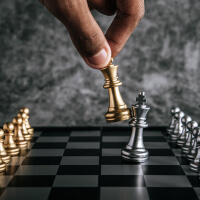

Description
Chess is a classic game of strategy and a highly competitive sport. It promotes the development of thinking, strategy, planning, and decision-making skills. It is a great game to strengthen your mental skills.

Possible Benefits
- May enhance your cognitive function
- May improve your reasoning
- May improve your sharpness
- May protect from dementia
- May boost your memory
- May improve creativity
- May improve confidence

Required Equipment
Chess board and pieces

How to Do It
If you are a beginner, it is best to get a tutor, take some classes, or learn the rules and moves on your own.
Join a chess club and/or play with friends regularly.
Why it works
- Chess implies a high activation of the prefrontal cortex, which is in charge of planning, decision making, reasoning, among others.
- It stimulates the ability of simulation, that is to say, to be able to imagine different scenarios in the mind and to take decisions from it.
- By requiring you to hold information about the opponent's moves and possible strategies, it strengthens your memory.

Time Commitment
50-90 minutes per game

Suggested Frequency
Once per week
Time of Day
Any

Possible Side Effects
None known.

Tips
- To make it more fun and challenging, use a chess clock.
- Be sure to refine your strategies to improve your skill in the game.
- When you have strengthened your strategies, enter competitions.
Supporting Studies and Articles
Expand Collapse- Planning abilities and chess: a comparison of chess and non-chess players on the Tower of London task. https://pubmed.ncbi.nlm.nih.gov/16848944/
- Chess Practice as a Protective Factor in Dementia. https://www.ncbi.nlm.nih.gov/pmc/articles/PMC6617066/
- Chess as a Behavioral Model for Cognitive Skill Research: Review of Blindfold Chess by Eliot Hearst and John Knott. https://www.ncbi.nlm.nih.gov/pmc/articles/PMC2972788/
- Chess Players Increase the Theta Power Spectrum When the Difficulty of the Opponent Increases: An EEG Study. https://www.ncbi.nlm.nih.gov/pmc/articles/PMC6981879/
- Secret of the Masters: Young Chess Players Show Advanced Visual Perspective Taking. https://www.ncbi.nlm.nih.gov/pmc/articles/PMC6821682/
- The Effects of Chess Instruction on Pupils' Cognitive and Academic Skills: State of the Art and Theoretical Challenges. https://www.ncbi.nlm.nih.gov/pmc/articles/PMC5322219/
Upgrade Yourself with our Breakthrough App
Get UltiselfMore Habits




Rate Habit
Play Chess